What is a Personal Learning Network?
A Personal Learning Network, or PLN is a way for people in their career field to connect and find resources that can help improve the outcome of what is trying to be accomplished. For example, a teacher that is not so well versed in technology might need the assistance from her school I.T. employee. Slowly but surely the I.T. person helps grow the teacher’s knowledge, but she still needs help on a frequent basis. However, after years of working together, the I.T. person ends up taking a job at another school in another state across the country. Now the teacher is left with very little technological help because the newly hired I.T. person in her school is not as helpful. The teacher decides to go to her PLN. She gets onto a teachers blog that the previous I.T. guy had bookmarked on her desktop. She requests any information on how to post her new assignments electronically for her students. Through this blog she is able to find the help that she needs from the insight of colleagues that do not directly work with her. Now the teacher knows that she can rely on the resources of her PLN to help get her by.
Other Benefits of a PLN:
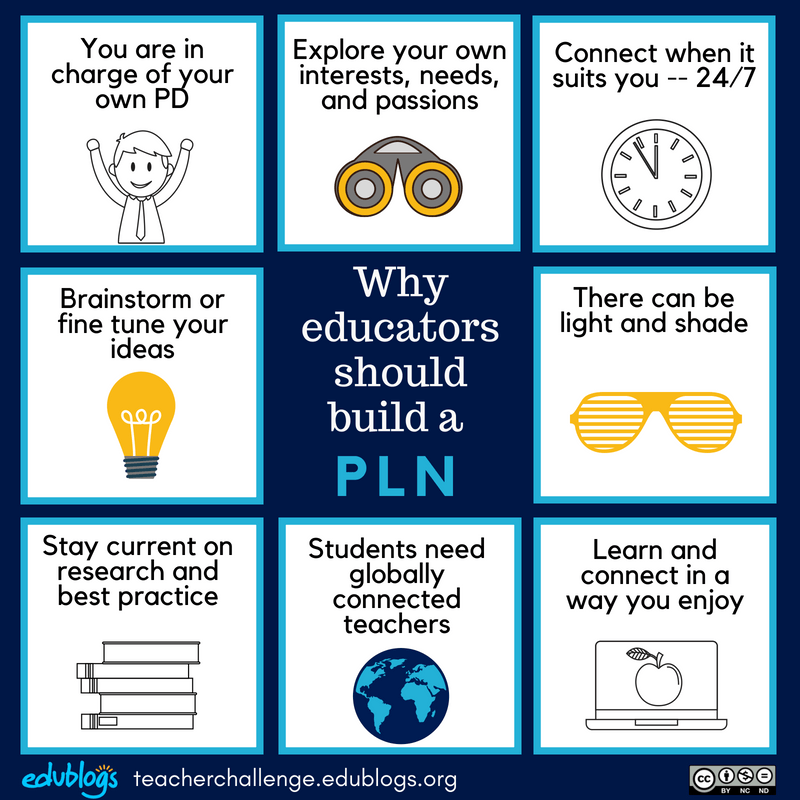
- You are in charge of your development plan & you can explore your interests
- Learning to connect in a way that is fun and exciting for you
- Stay current on the happenings in your profession on a state, country, or global level
- Allows for getting a general knowledge of or fine tuning thoughts and/or ideas
Five Professional Organizations Related to Elementary Education
- This organization is called First. It is a project based, hands-on experience for kids ages six through eighteen. The organization focuses on the science, technology, engineering, and math programs(STEM). The programs they have currently for elementary aged kids are called “Boomtown Build” and “City Shaper”. The Boomtown program allows for students to build an early interest in any of the STEM programs with the use of Legos, and by learning the concepts of discovery, teamwork, and innovation. In the City Shaper program kids will learn about energy, recycling, food safety, and how to solve real world problems. https://info.firstinspires.org/first-rise-2020
- This organization is called the American Federation of Teachers(AFT). They have different categories for employees in the educational field. This could be anything from teachers, paraprofessionals, to higher up administrative positions, and nurses and other health care professionals. Under the “pre-k -12 public education” section they have a small news section for what is happening in the education field. They also have a “positions” tab that tells about success stories of people in a specific field of education. They also have “featured resources”. Under this tab there are things like how to support a student with autism, and how to share and gain ideas from lessons that other people have posted. https://www.aft.org/education
- The National Association of Special Education Teachers(NASET) is an organization that provides support and assistance to teachers either already in or planning to enter the field of special education. They strive to promote the best education possible for students with exceptionalities. This site allows for teachers to stay current with events happening in the special education field so both the student and teacher can adapt to the changing world around them. The site can also be used as a national forum for ideas in the education of children with special needs. https://www.naset.org/index.php?id=naset
- The organization called the National Council of Teachers of English(NCTE) helps provide support for teachers and their students. They give lists of books that may help teachers grow their voice as advocates for their students. This organization also allows for educators to share research, teaching strategies, and lesson ideas through its annual convention or other learning events. https://ncte.org/
- The ASCD organization believes in educating the “whole child”. They believe that education should not be only directed towards the curriculum, but rather the development of students creative and moral capacities. A student has many more diverse needs that what is just taught in the set curriculum. The organization provides books, webinars, conferences, videos, and online learning to help the teacher provide the more well-rounded education to their students. http://www.ascd.org/
Integrating Technology into Education
- This website from Saint Mary’s University of Minnesota describes three ways that technology can be used in the classroom. One way is using computers for Web Quest type activities. The second is using an interactive white board to get the students more involved in the lessons. The third way is to use digital presentations. This would be more entertaining for the students to watch and/or create versus a standard PowerPoint. https://onlineprograms.smumn.edu/meldt/masters-of-education-in-learning-design-and-technology/resources/3-ways-to-integrate-technology-into-the-classroom
- This website gives a whole list of different activities to do in the classroom using technology. It seems to focus on activities that you could do by giving suggestions for the amount of devices you might have access to; for example, with three to five computers students could get on a collaborative document and work together on a site much like Google Docs. https://www.edutopia.org/technology-integration-guide-implementation
- This blog post had twenty-five ways to use technology in the classroom. There were things like creating mini online assignments to be used as exit tickets, virtual field trips, running learning stations by providing videos & podcasts, and sharing an online class calendar. The calendar might be a good idea so that way the kids can sign on and have access to everything at once to see when assignments are due. Parents could also gain access to the calendar to see what their child is up to. https://www.prodigygame.com/blog/ways-to-use-technology-in-the-classroom/
- This site tells how technology can be beneficial in a classroom setting. One way is allowing students to go beyond the physical boundaries of the classroom and explore in a world of their own. Another benefit is that it can expand the students engagement with different forms of information & it allows for more information to be accessed. A final benefit would be expanding the ways in which students can demonstrate what they have learned through the activities. https://teaching.berkeley.edu/resources/engage/incorporating-technology-your-teaching
- This site gives ten ways in which technology can be used in the classroom. Some examples include using an interactive white board for morning check in, having digital books read aloud to students so they can gain a better understanding, and taking a quick recording of a student that might be modeling good behavior to show the class the behavior that the teacher would like replicated. https://www.earlychildhoodeducationzone.com/10-ways-to-integrate-technology-into-your-classroom/
Professional Development Workshops
- The New Jersey Educational Computing Cooperative (NJECC) located in Cedar Grove New Jersey, has a mission to help integrate technology into an educational setting in grades K-12. They provide workshops, conference events, and monthly meetings to achieve this goal as it applies to professional development. It seems to also be a good resource when it comes to PLN’s because they also have a forum for finding solutions to problems and for sharing success. They also provide many opportunities for good networking. http://www.njecc.org/
- Edcamp is an organization that provides professional development for teachers by teachers. The location for this Edcamp event was in Ramsay, New Jersey. The workshops they have provide people attending it the information they need to manage a classroom in the best way possible. Many of the workshops also provide insight on how to increase the use of technology into more lessons in the classroom to engage students in learning. https://www.edcamp.org/
- The New Jersey Association Education and Research Foundation (NJERF) provides and an event for educational staff called “Techspo”. This is held in Atlantic City. They have many events that tell about the use of technology and how it can be useful to teachers. One of the workshops that I was reading about taught teachers how to make all of their online documents, power-points, or whatever they are using in the class to be compliant with the Americans with Disabilities Act. I am sure that would be something that is beneficial for newer teachers to the field that do not have much experience with that type of thing. https://www.njasa.net/
 Technology In Teaching